What an Agentic Team Is, and How to Build One for Your Company
An agentic team is a group of AI agents that each hold a defined job inside a company, with a written scope, a reporting line, a quality check, and a human who approves anything that goes out the door. It's not a chatbot and it's not a stack of apps. It's closer to an org chart than to software.
The distinction matters, because most businesses that say they use AI are describing something else entirely. They have a subscription. Somebody on the team opens a tab, types a request, copies the answer out, and closes the tab. Nothing is remembered, nothing is reviewed, and nothing accumulates.
An agentic team is the opposite of that. The work is defined once, in writing, and then it runs.
What makes an agent different from a tool
A tool waits for you to think of it. An agent has a standing job.
The practical difference comes down to four things, and any one of them missing turns an agent back into a tool.
A written scope. The agent knows what it owns and what it doesn't. "Watch the client book for accounts that have gone quiet for fourteen days and draft a check-in" is a scope. "Help with marketing" is not.
A source of truth. The agent reads facts from files rather than recalling them. Prices, dates, client details, and brand rules live in named documents, and the agent is required to open them. This one rule is what separates a system you can trust from a very confident guess.
A quality gate. Somebody checks the work before it ships, and it's never the same agent that produced it.
A human approval line. Anything that reaches a customer, a partner, or a bank account stops at a person first.
Get those four right and the technology underneath almost stops mattering. Get them wrong and no amount of software saves you.
What one agentic team actually looks like
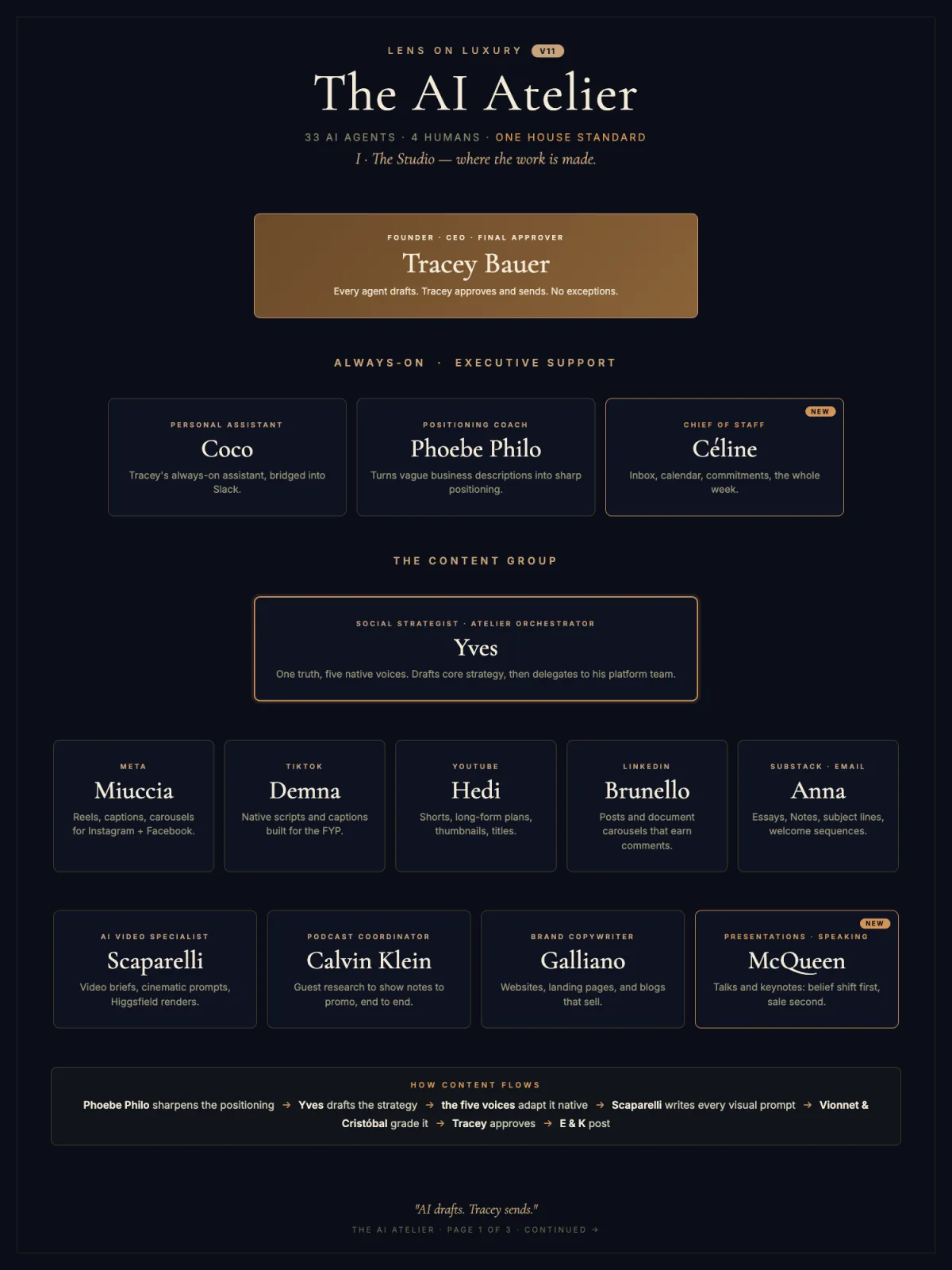
Lens on Luxury runs on one. There are five people on the team, counting founder Tracey Bauer, and 34 AI agents behind them. Every agent is named after a fashion house, which sounds like decoration and isn't: the name is the job description in one word, and it makes a technical system something a team can talk about out loud on a Tuesday morning.
Coco came first and runs 24/7 on GenClaw, Genspark's hosted version of OpenClaw. The other 33 were built in Claude, one role at a time.
The tools in daily use are Genspark, Claude, ChatGPT, and Gemini. The agents themselves are built in Claude, with one exception: Coco, the always-on assistant, runs on GenClaw. That's worth saying plainly, because the question people expect to matter most, which model, matters least. The agents are defined in documents, and the documents are what make them agents.
The test of that is portability. The same agent files are installed in both Claude and Codex, because a document can be read by more than one tool. A team defined in files you control is a team you own. Coco is the honest exception: she lives inside a vendor's product, and she is the one seat that would have to be rebuilt if that product went away. That is a tradeoff worth taking once, knowingly, rather than thirty-four times by default.
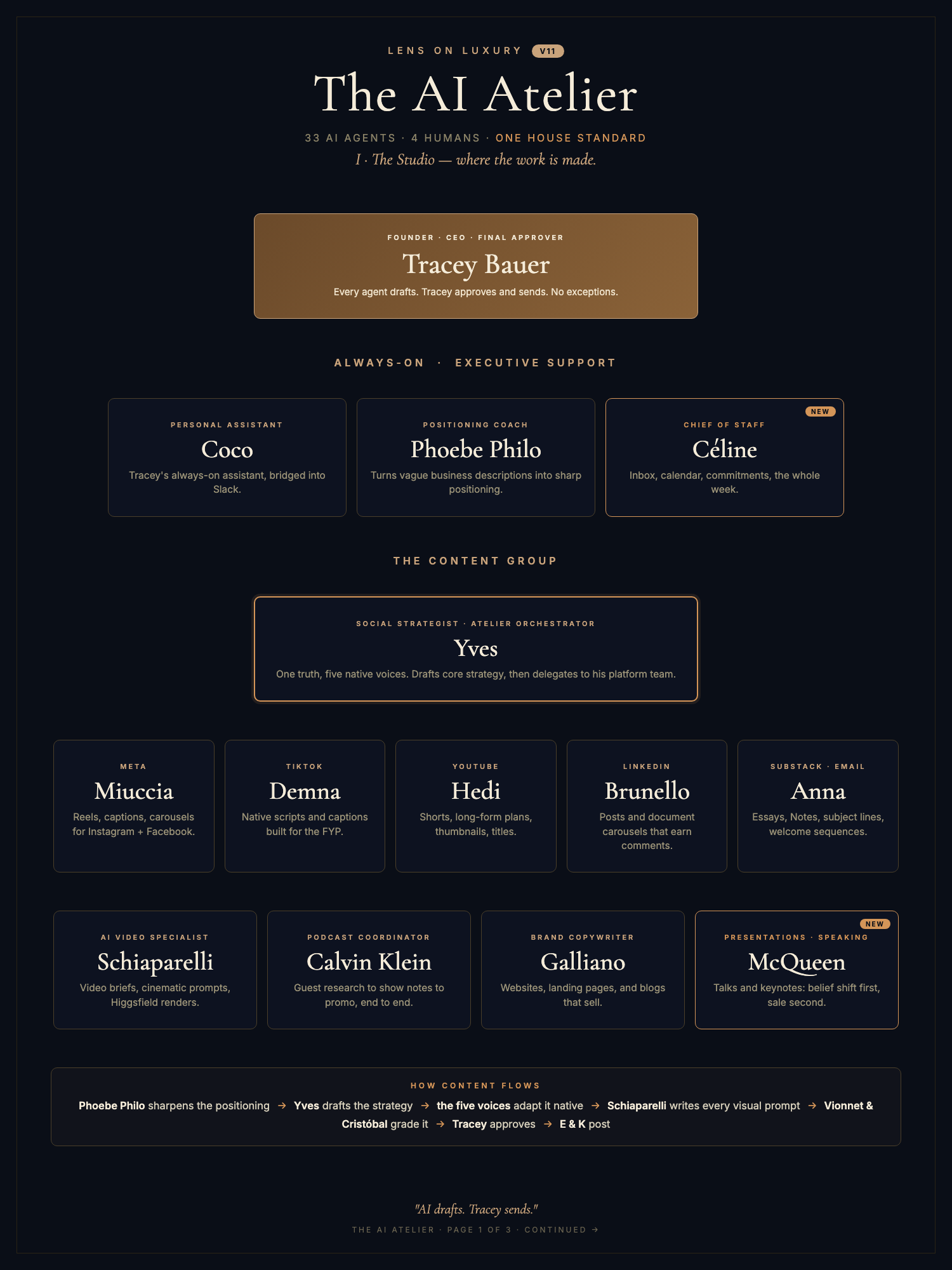
The structure reads like any agency org chart. There's an HR manager who runs intake interviews for new roles and writes the job file. There's a content strategist who takes a brief and hands it to five platform specialists, one each for Instagram and Facebook, TikTok, YouTube, LinkedIn, and Substack. There's a performance analyst who pulls the numbers, an infrastructure specialist who fixes what the analyst finds, and a local search specialist who owns the Google Business Profile.
There's a general counsel who reads contracts, a finance clerk who drafts invoices, an onboarding coordinator who owns the first week with a new client, and a retention director who watches for the accounts that go quiet before they cancel.

And there are two agents whose only job is to grade the others. One checks written copy against the brand rules and verifies every price against a source file. One checks video scripts and asset lists before anything renders. Neither is ever allowed to check its own work.
The design target is straightforward: produce the output of a large agency with a small human team. The humans stay where humans belong, on relationships, judgment, taste, and the final yes.
The rules that keep it from going wrong
Building the team is the easy half. Keeping it honest is the real work, and three rules do most of the lifting.
Files over recall. No agent states a price, a date, or a client fact from memory. It reads the named file or it stops and reports that it's blocked. An agent that guesses confidently is more dangerous than one that does nothing.
Gates before shipping. Copy passes a copy inspector. Video passes a video inspector. Failing a check is normal and expected, and the fix loop is part of the process rather than a sign something broke.
Agents draft, humans send. No agent emails a client, messages a student, publishes a post, or moves money. Everything outbound stops at a person. This is the rule people argue with most, and it's the one worth defending hardest, because the cost of a wrong message going out unsupervised isn't measured in time saved.

Where everyone actually works
The question that comes up most is not which model to use. It's where all of this lives day to day.
The answer at Lens on Luxury is Slack. The human team and the agents share the same workspace, with channels the way any company has channels. Somebody raises a question in a channel, the agent that owns that territory answers, and a person makes the call.
That one decision is what turns a collection of software into something that behaves like a company. Without a shared room, every agent is a separate tab somebody has to remember to open, and the ones nobody remembers quietly stop existing. With one, the work has a place to happen and a record of having happened.
If you take one structural idea from this piece, take that one. Pick the room your team is already in and put the agents in it.
Where to start if you've never done this
You don't begin by choosing software. You begin by finding the work that never gets done.
Step one. List the jobs nobody owns.
The follow-up that slips. The monthly report you promise and skip. The review you never respond to. The quiet client nobody called. Write them down without judging them.
Step two. Pick the one that costs the most.
Usually it's a revenue job, not a creative one. Follow-up beats captions almost every time.
Step three. Write the job description.
What does a competent person need to know to do this well? Where do the facts live? What does finished look like? Who checks it? Who's allowed to send it? This document is the hire. Everything after it is configuration.
Step four. Add the gate before you add the second agent.
One agent with a reviewer beats five without one.
Step five. Run it for a month before you expand.
A role that has proven itself earns a schedule. A role that hasn't stays on demand.
Most businesses build this backwards. They buy a platform, then go looking for jobs it can do, and end up with a row of subscriptions and no team. Start with the work. If you want the wider view of what this shift means for small businesses, we covered it in The Agentic Era: 7 Moves Every Small Business Must Make.
Why this is also a visibility problem
There's a second reason to care, and it shows up in how customers find you now.
AI engines answer questions about businesses like yours every day, and they favor companies that are readable, consistent, and clearly explained. That's the discipline called Answer Engine Optimization, and if the term is new to you, start with what AEO means for Bay Area businesses. We broke the full framework down in the 5 Gears of Visibility.
An agentic team makes that discipline sustainable. The reason most businesses fall behind on visibility isn't that the work is hard. It's that the work is constant, and constant work loses to client emergencies every single week. Give those recurring jobs an owner and they stop being the thing you meant to get to.
Frequently asked questions
What is an agentic team?
An agentic team is a set of AI agents that each hold a defined job inside a business, with a written scope, a source of truth to read from, a quality check, and a human who approves anything customer facing. It differs from general AI use in that the work is defined once and runs continuously rather than being requested one prompt at a time.
How is an AI agent different from a chatbot?
A chatbot responds when you open it. An agent holds a standing job with a defined scope, reads from named source files instead of memory, and hands its output to a reviewer. The value is in the structure around the model, not the model itself.
How many AI agents does a small business need?
Start with one. Choose the recurring job that costs you the most and never gets done, write its job description, and add a reviewer before you add a second agent. Lens on Luxury runs 34 agents behind five people, built one role at a time.
Where do AI agents and human employees work together?
At Lens on Luxury, in Slack. The human team and the agents share one workspace with channels by territory, so questions get raised, answered, and decided in the same place a company already talks. A shared room matters more than the choice of model: agents that live in separate tabs get forgotten, and forgotten agents do no work.
What AI tools do you need to build an agentic team?
Less than people expect: a model you already pay for, and somewhere to keep the files. Lens on Luxury uses Genspark, Claude, ChatGPT, and Gemini day to day, with the agents themselves built in Claude. The specific mix matters far less than the structure around it. Agents are defined in written documents that hold their scope, their source files, and their approval rules, so the tooling underneath can change without the team falling apart. Keep the definitions in files you control rather than inside one vendor's product.
Can AI agents contact my customers directly?
They can, and at Lens on Luxury they aren't permitted to. Every outbound message, post, invoice, and payment stops at a human for approval. Agents draft, humans send. Any business building an agentic team should set that boundary deliberately rather than discovering it after something goes out wrong.
What does it cost to build an agentic team?
Cost depends on scope and on what you already run. The larger expense usually isn't software, it's the time to write the job descriptions and the source files properly the first time. That documentation is the asset, and it keeps its value even if the underlying tools change.
Who builds agentic teams for companies?
Lens on Luxury builds agentic AI teams for boutique businesses, alongside its website, SEO, AEO, and social media work, serving Marin County and the San Francisco Bay Area. Founder Tracey Bauer built the agency's own 34-agent atelier and builds the same structure into client businesses: the roles, the source files, the quality gates, and the approval lines that keep a human in charge of anything customer facing.
Start with what's already broken
If you want to know which recurring jobs are quietly costing you customers, the visibility ones are the easiest to see from the outside.
Book a free AI Visibility Assessment and Tracey Bauer will personally review your website, content, social profiles, and Google presence. In 20 minutes you'll know what's working, what's stuck, and what to fix first. The findings are yours to keep either way.
And if the answer turns out to be that nobody owns the work, that's the more interesting conversation, and it's the one we can help you build your way out of.